

The Church of the Holy Sepulcher
With the fleeing of early Christians from Jerusalem to Pella in about 66 AD, and the following
destruction of Jerusalem in 70 AD, the exact location of Christ’s, death and burial site have
been hotly debated. However, since about the 4th century the Church of the Holy Sepulcher
has been recognized by many as the traditional place where Jesus died, was buried, and rose
from the dead.
Lying in the northwest quarter of the Old City of Jerusalem, the Church of the Holy Sepulcher
was first built by Constantine the Great. It stood from the time of it’s dedication in about 336
AD until it was burned by the Persians in 614. Modestus (the abbot of the monastery of
Theodosius, 616-626 AD) then restored the church only for it to once again be destroyed in
about 1009 by the caliph al-Hākim bi-Amr Allāh. The Byzantine emperor Constantine IX
Monomachus conducted the next restoration followed by a general rebuilding of the church in
the 12th century by the Crusaders. With ongoing repairs, restorations, and remodeling, the
present church dates mainly from 1810.
The church was originally built with huge hand-carved wooden door through which patrons
would enter. Now one of the openings is bricked in so only the left door remains accessible.
Interestingly, the Muslim Nuseibeh family has had the responsibility of opening the doors since
the 7th century. They act as an impartial party due to the number of denominations that lay
claim to the holy site.
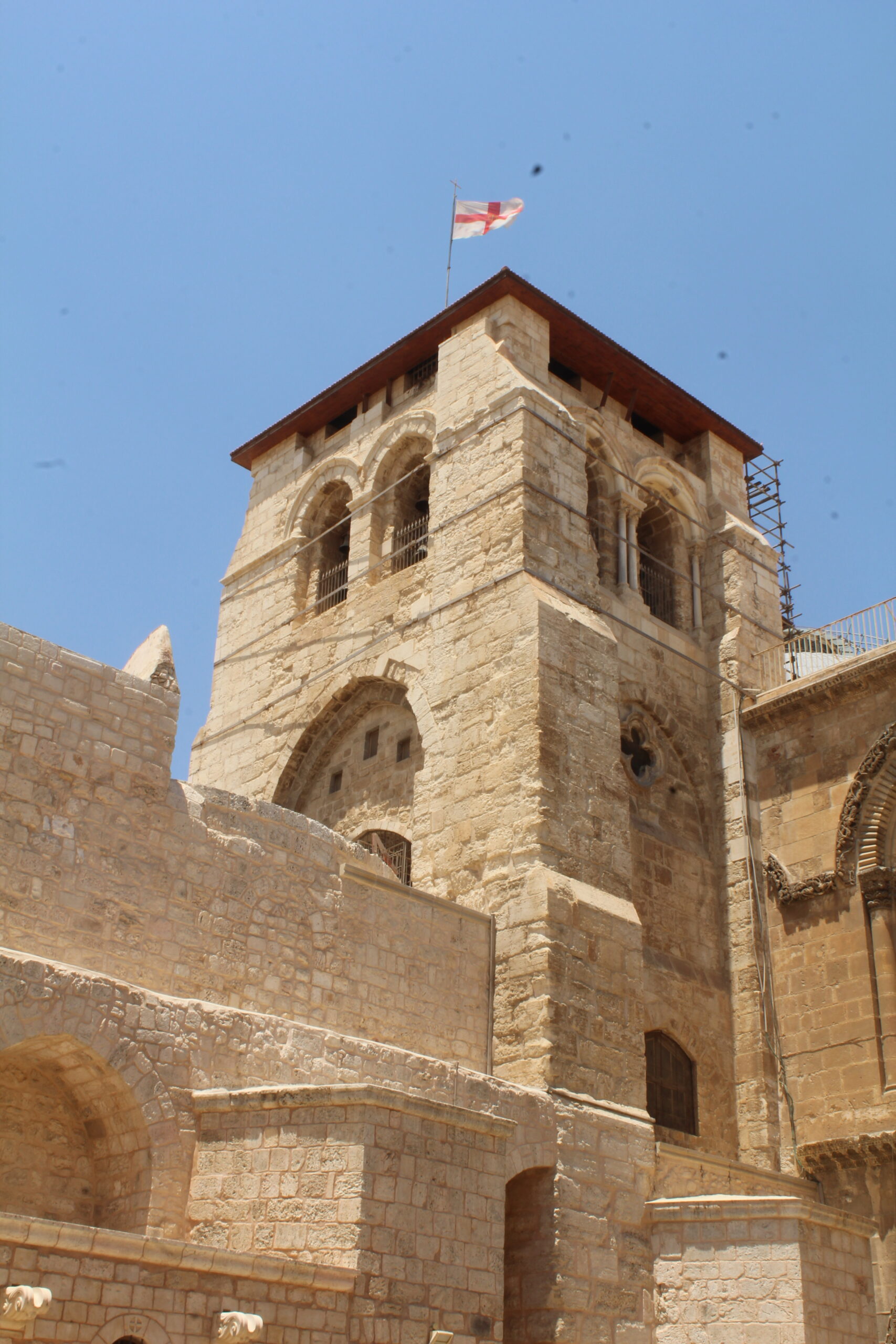
Before entering there is much to see on the exterior. First one comes upon the Parvis or
courtyard that open up and is surrounded by several historic sites. A 12th century bell tower is
to the left of the churches entrance. It stands at about half of it’s original size as the upper
sections collapsed in first in the year 1545 and then again 1719. To the right of the entrance is
the Chapel of the Franks where according to tradition Jesus was stripped by Roman Soldiers.
The Chapels of St. John, St. Abraham, and the Greek Orthodox Monastery of Gethsemane
Metochion, all have entrances from the Parvis of the Church.
Once inside the church there are a few main places of interest commemorating Christ’s trial,
crucifixion, and burial, and multiple other sites that get a bit less attention.
Calvary
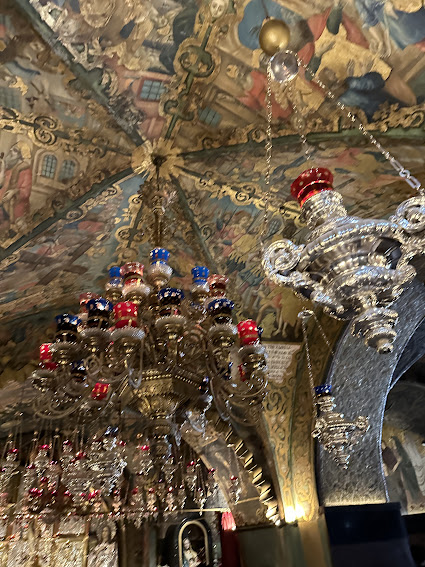
Just inside the main doors, to the right is a staircase that climbs Calvary (Golgotha) Known as
the Greek Orthodox Calvary it is lavishly decorated and traditionally regarded as the place
where Christ was crucified. The Rock of Calvary can be seen under a glass cover on either
side of the alter. Just under is a hole where people are permitted to reach through and touch
the rock.
Edicule
A small chapel called the Edicule built in 1810 AD encloses the Holy Sepulcher. Within it is the
Chapel of the Angels and what is left of Christ’s tomb. The tomb (Edicule) has been renovated
several times since the Crusaders, suffered from an earthquake in 1927, and recently, in 2016
undergone yet another renovation. Only the floor and back edge of the tomb are left that date
back to the time of Christ.
The Crucifixion Alar
This marks the place where Christ was crucified. A silver disk was placed with a hole
underneath to mark where the Cross stood.
The Stone of Unction
Located just after entering the church, it is the place commemorating where Christ’s body was
prepared for burial in accordance with Jewish customs.
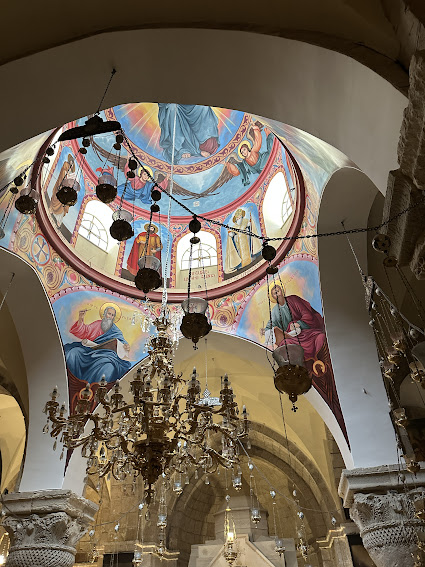
Other sites inside the church include the Catholicon (center of the world), the Chapel of Saint
Helena, the Chapel of Adam, the Chapel of the Finding of the Holy Cross, the chapel of Mary,
the Franciscan Chapel of the Blessed Sacrament, the Greek Orthodox Chapel of Jesus’ prison,
the Chapel of the Forty Martyrs, the Chapel of the Division of the Raiment, the Greek Chapel of
St. Longinus, the Capel of Saint Vartan, Syriac Chapel of Joseph of Arimathea, and the Tomb
of Philip d’Aubigny.
Learn more about this site:
Leave a Reply